
Midland County Court Records After a Jail Arrest
Midland County court records after a jail arrest follow a practical sequence: arrest, booking at the jail, first appearance or magistrate review, bond decision, prosecutor review, and a court filing if charges are accepted. The custody record and the court record overlap, but they are not the same record. The public detainee roster can show the arrest-side information that jail staff are tracking, while the court file is the official case track for filed criminal charges.
The jail roster is useful for current custody, offense wording, class, court number, county, warrant number, arrest date, bond, fines, disposition, and time columns. For roster and booking context, use jail inmate records. For booking-photo availability, use jail mugshots. The court record itself is where formal charges, amendments, dismissals, pleas, judgments, and final case disposition should be checked after an arrest.
From Arrest to Court Records
A Midland County arrest may start with the Sheriff's Office, Midland Police Department, DPS, another Texas agency, or execution of a warrant. After transport to the Central Detention Center, jail intake handles identity, property, fingerprints, photo processing, warrant and hold review, security screening, and classification. That jail process can produce a current detainee entry before a prosecutor has made the final filing decision.
- Arrest: An officer or warrant brings the person into custody.
- Booking: Jail staff create the custody-side record and review holds, warrants, bond information, and charge rows.
- First appearance and bond: A magistrate or court process addresses probable cause, release conditions, and whether bond is available.
- Prosecutor files charges: The District Attorney or other responsible prosecutor decides whether to file, modify, reject, or pursue charges by information or indictment.
- Court record opens: The filed charging document creates or updates the criminal case record that the clerk and court track.
This timing matters because a booking charge printed on the roster can differ from the court charge that later appears in the case file. A roster may show a warrant hold, bench warrant, probation issue, or arrest-level offense, while the court record may show a different formal count, a reduced charge, an added count, or a dismissal.
How to Find Court Records After an Arrest
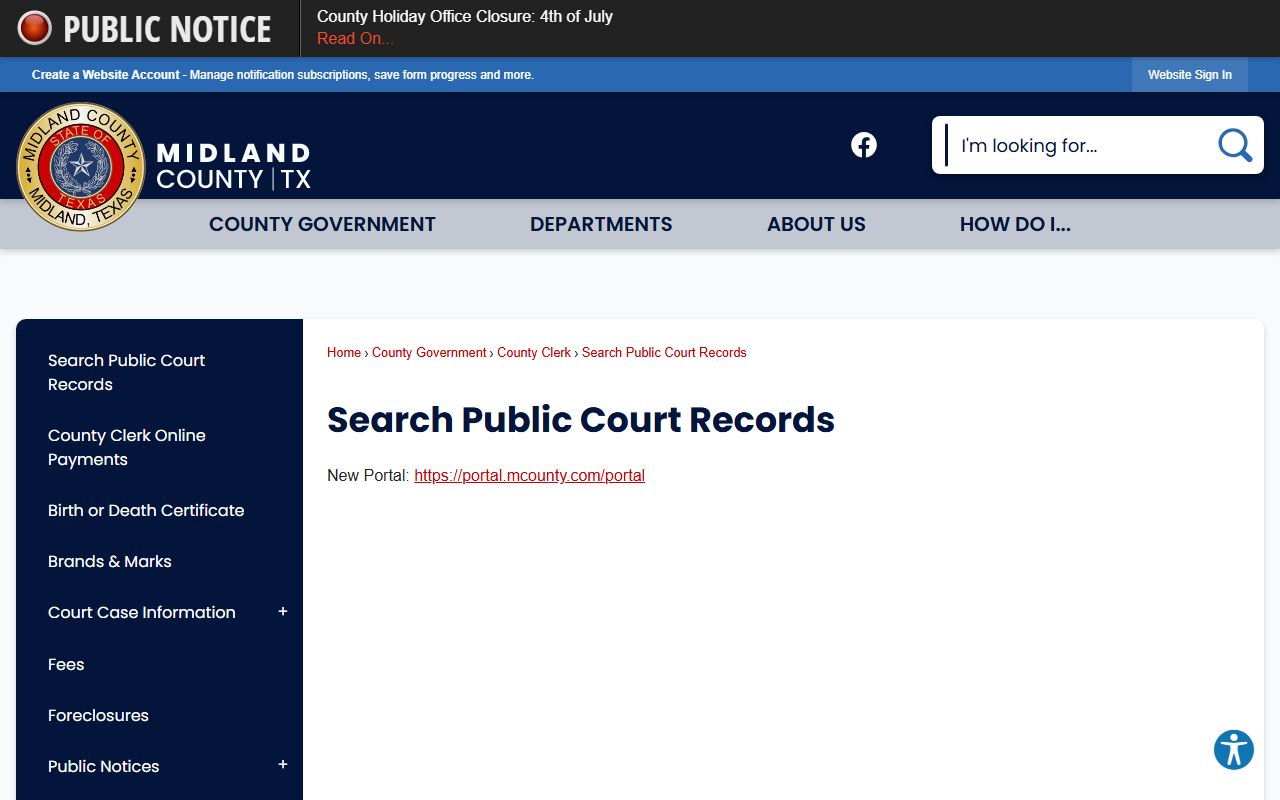
The official county court-records page is the starting point for the court side of the search. Midland County's Search Public Court Records page says an account must be created to access data and links to the official Midland County portal. It also links to the County Clerk municipal online payments portal. The research did not inventory portal search fields behind the account wall, so search options should be confirmed after login.
| Field or Access Point | Type | Required | Limits and Notes |
|---|---|---|---|
| Public Clerk Records / county portal account | Account or login path | Yes, per county page | The county page states an account has to be created to access data. |
| Search terms inside portal | Portal search field | Unknown before account access | May support name or case-number searching, but exact fields were not confirmed without login. |
| Official court portal | Hyperlink | n/a | Use portal.mcounty.com/portal from the county court-records page. |
| County Clerk payment portal | Payment and records account portal | Account path may apply | Linked by the county page for clerk-related online payments and account access. |
- Start with the current detainee roster to confirm the person was held and note the offense, court number, county, warrant number, arrest date, bond, fines, and disposition if shown.
- Open the county Search Public Court Records page and continue to the official portal account path.
- After account access, search by the available name, case number, or warrant number fields shown by the portal.
- Compare the court charges to the roster charges. Treat differences as a signal to read the filed case, not as proof that either record is wrong.
- If the case does not appear online, contact the relevant clerk. Older, sealed, expunged, or restricted matters may not be available through public portal access.
The county public court-records page is shown in the project image below. The source page identifies the account requirement and links the court portal used for Midland County public court records.
Use that court portal for the formal case path. Use the jail roster for custody status and booking-level charge rows.
District Attorney and Charging Decisions
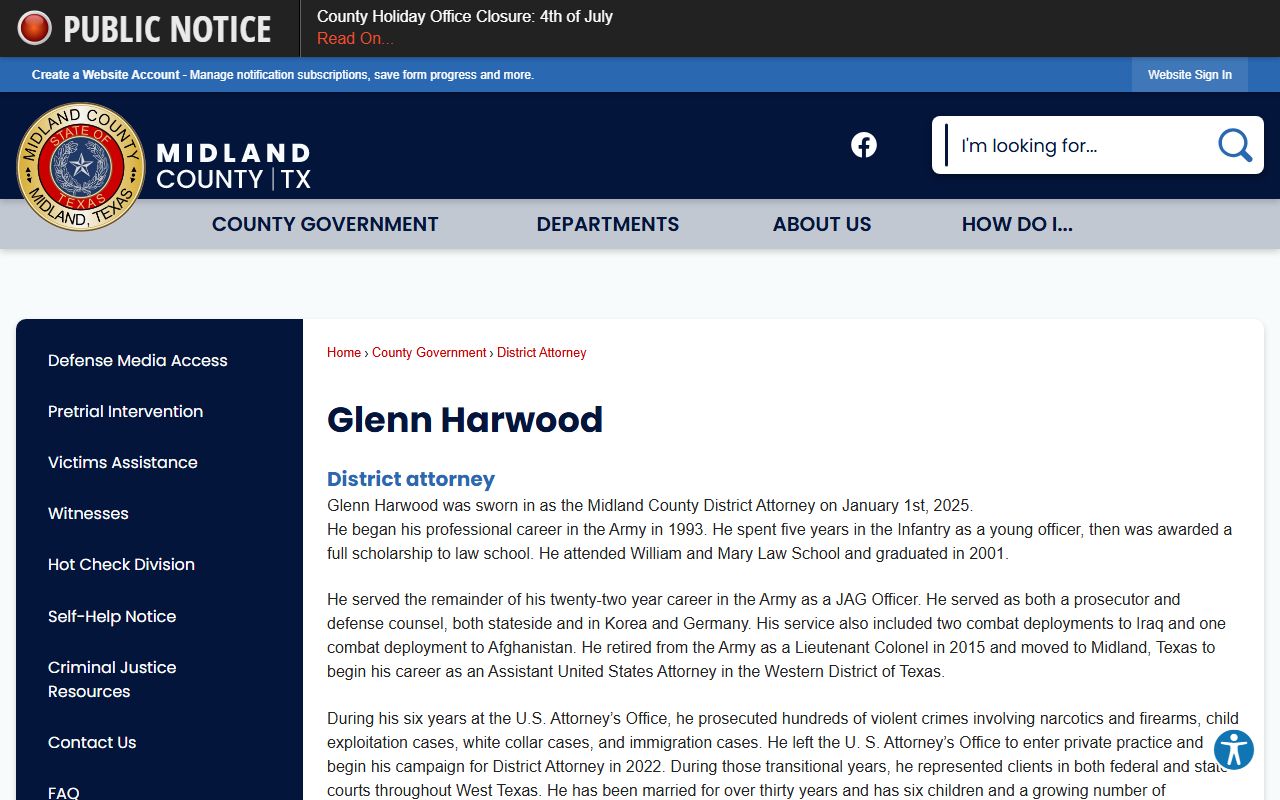
Midland County District Attorney Glenn Harwood was sworn in on January 1, 2025. The District Attorney represents the State of Texas in criminal matters for the district and is the local office tied to many formal charging decisions after an arrest. The office should not be treated as a personal legal-advice source for defendants or families. For court dates, the detention FAQ directs users to contact the inmate's attorney.
The District Attorney's Office is listed at 500 N Loraine St, Suite 200, Midland, TX 79701. Phone is 432-688-4411, fax is 432-688-4938, and eFile service email is DAService@mcounty.com. The staff directory lists hours as 8:00 AM to 12:00 PM and 1:00 PM to 5:00 PM. DA divisions include felony, misdemeanor, juvenile and Veterans Court, protective orders, pre-trial intervention, and investigators.
The official District Attorney image below identifies the DA office source used for the Glenn Harwood and office-contact details.
Charging decisions can change the case after booking. A filed information, indictment, amendment, dismissal, or rejection may make the court record look different from the jail entry that first appeared after arrest.
Charging Documents After an Arrest
The court record begins to take shape when a formal charging document is filed or when a pending matter is otherwise opened in the appropriate court. The terms below are common criminal-case markers. They should be read with the case docket and clerk record because local practice and offense level affect which document appears.
| Complaint | Information | Indictment | |
|---|---|---|---|
| Filed By | Officer, prosecutor, or sworn complainant depending on context | Prosecutor | Grand jury |
| Common For | Initial accusation, warrant support, or lower-level criminal matters | Many prosecutor-filed non-indicted cases | Felony matters presented to a grand jury |
| Effect on Record | Documents the allegation or probable-cause basis | Sets out formal charges filed by the prosecutor | Shows grand-jury accusation and felony case path |
| What to Compare | Roster offense and arrest date | Filed count, level, and amendments | Indicted count, cause number, and later disposition |
Charge Status in Court Records After Arrest
Charges are not fixed just because a person was booked. A case can remain pending, be amended, be reduced, be dismissed, proceed to plea, proceed to trial, or end in another disposition. Midland County roster rows can show jail-level offense, class, court, county, warrant number, arrest date, bond, fines, and disposition, but court charges may differ after prosecutor review.
| Status | What It Means | How to Read It |
|---|---|---|
| Pending | The charge has not been finally resolved. | Check future settings, bond conditions, and whether other counts were added. |
| Amended | The filed charge was changed after the original filing. | Compare the original count, amended count, offense level, and filing date. |
| Reduced | A lower charge or lower offense level replaced or modified the original allegation. | Do not describe the original booking charge as the final conviction without checking disposition. |
| Dismissed | The charge was terminated and not pursued to conviction. | Look for whether other counts in the same case remained active. |
| Nolle Prosequi | The prosecutor declined to proceed on that charge. | Read the docket to see whether it applies to one count or the entire case. |
| Convicted | A plea or finding resulted in final adjudication. | Confirm the exact offense of conviction, sentence, and judgment date. |
Bond and Release After an Arrest
Texas bail is governed primarily by Texas Code of Criminal Procedure Chapter 17. In Midland County, the practical bond source is the detainee roster plus the detention FAQ and Money Deposits page. The FAQ says a user's first place to check a person's bond is the Current Detainees link, because the roster includes a Bond column by charge row. A printed amount such as $.00 should not be read as automatic release. It may mean no bond, a not-yet-set bond, a warrant hold, a probation hold, or another status.
| Bond Type | How It Works | Midland County Notes |
|---|---|---|
| Cash Bond | The full amount is paid through the court or jail process. | FAQ says cash bonds are receipted to the defendant, and only the defendant may receive an eligible refund. |
| Surety Bond | A licensed bail bond company posts bond for the defendant. | The FAQ says bail bond companies are listed in the phone book's white pages. |
| Personal Bond / PR Bond | Release is based on a promise to appear and any ordered conditions. | Texas law allows personal bonds, but no Midland-specific public PR schedule was located. |
| No-Bond Hold | Posting money does not secure release while the hold remains active. | May involve bench warrants, probation violations, out-of-county holds, immigration or federal holds, or court orders. |
| Class C / Time-Pay Issue | Municipal court payment may affect release on some lower-level matters. | The FAQ directs time-pay release questions to City of Midland Municipal Court, 201 E Texas, Midland, TX 79701. |
For local posting, the Money Deposits page says bail payments must be made through the Central Detention Facility kiosk using cash or credit/debit card, or online through TouchPay Online. The kiosk is available during normal lobby hours at the Central Detention Facility. The county also states that for each credit or debit card transaction, TPH charges the base fee plus 7.5 percent of the face amount.
| Bail Payment Amount | Cash Fee | Credit Card Fee | Debit Card Fee |
|---|---|---|---|
| $0 to $100 | $5 | $5 | $5 |
| $100.01 to $200 | $10 | $10 | $10 |
| $200.01 to $9,900 | County page prints additional $500 per $100 deposited; verify before paying | $10 | $10 |
For cases higher than Class C misdemeanors, the FAQ says a defendant may be eligible for a cash-bond refund if the case is dismissed or resolved. If the case was filed in criminal court, the money is deposited with that clerk. If the case was dismissed before filing or indictment, the jail may refund it. The defendant needs the cash-bond receipt, court paperwork showing dismissal or resolution, and government ID.
Warrants That Lead to Court Records After Arrest
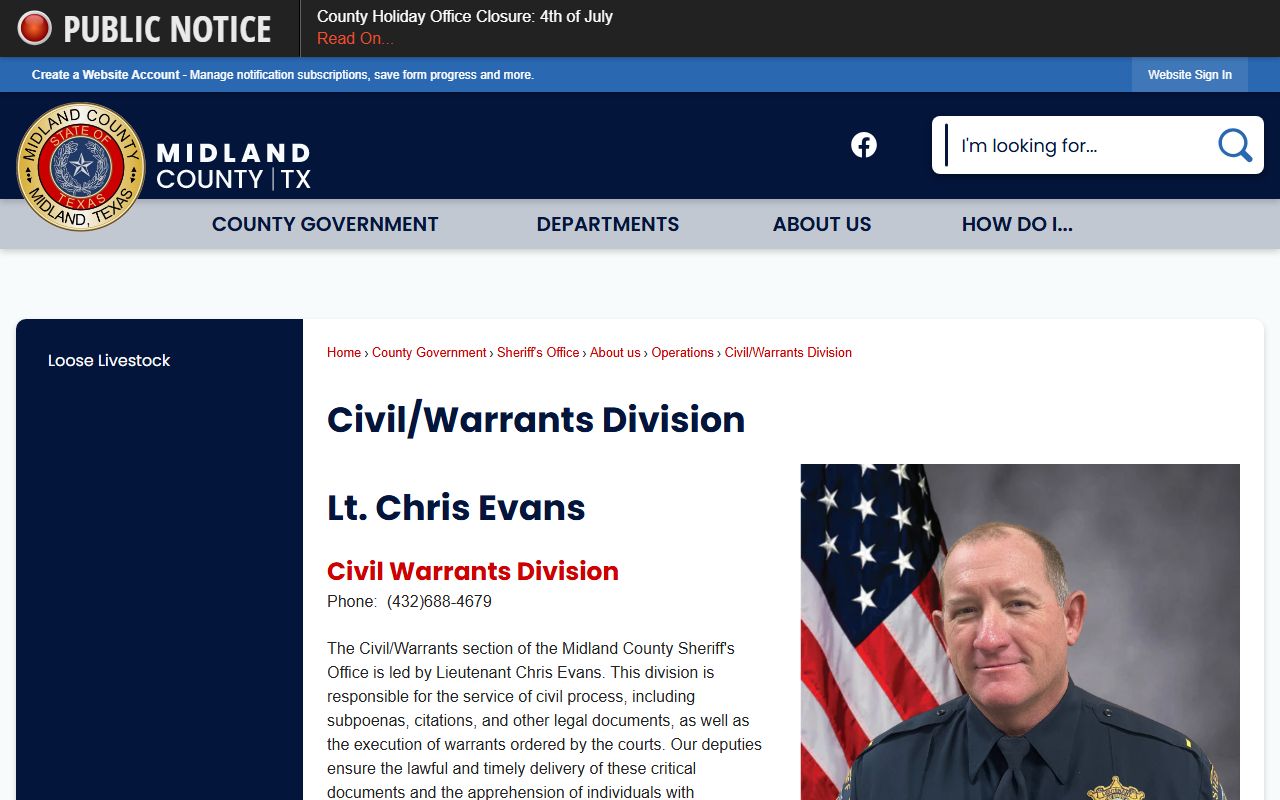
No public online active-warrant search was found in the official Midland County sheriff navigation reviewed in the research. The official warrant access channels are the Civil/Warrants Division and the detention FAQ. The Civil/Warrants Division page lists phone 432-688-4679 and describes service of civil process, subpoenas, citations, other legal documents, and execution of warrants ordered by the courts. The FAQ warrant line is 432-688-4680. Both numbers should be labeled by source because they are not the same number.
If a warrant has already led to a jail booking, the roster may show an offense such as BENCH WARRANT, plus court, county, warrant number, arrest date, bond, and disposition. A court portal account may show case-related warrant entries after login. A sheriff public-information request may be needed when a warrant or arrest record is not online. A search warrant is different: it authorizes a search and does not necessarily mean the person was booked unless an arrest follows.
The Civil/Warrants Division image below is from the official county source that identifies the warrant-service division and contact channel.
For lower-court bench warrants, also remember the detention FAQ's local note: City of Midland Municipal Court at 201 E Texas handles time-pay release matters for municipal court.
Charges vs Convictions
An arrest and a charge are not the same as a conviction. A charge is an accusation or filed count. A conviction is a final adjudication after a plea, trial finding, or judgment. The difference is especially important when court records after an arrest are used to understand employment concerns, housing concerns, family-law questions, or personal case history.
| Charge | Conviction | |
|---|---|---|
| Stage | Accusation, arrest-level entry, or formal filed count | Final plea, verdict, or judgment |
| Proof Level | Often tied to probable cause or prosecutor filing review | Requires a guilty plea, finding, or judgment under the criminal-case process |
| Can Change? | Yes. Charges may be amended, reduced, added, rejected, or dismissed. | The final judgment can still have appeal, modification, or record-clearing issues, but it is not merely an accusation. |
| Public Record Effect | May appear on the roster, court docket, or prosecutor filings | May appear as judgment, sentence, or disposition unless restricted by law or court order |
Sealed vs Expunged Arrest Records
Texas access rules combine public-information law, court-record rules, criminal-history rules, and record-clearing statutes. Texas Government Code Chapter 552 governs public information. Texas Government Code Chapter 411 governs criminal-history record information. Texas Code of Criminal Procedure Chapter 55 governs expunction after qualifying outcomes. Those laws matter because a court case, jail booking entry, prosecutor file, and DPS criminal-history entry may be handled through different systems.
| Sealed | Expunged | |
|---|---|---|
| Public Visibility | Hidden from many public searches after a qualifying order, but not necessarily destroyed. | Records are destroyed, deleted, or returned as directed by the expunction order. |
| Agency Access | Some government or justice-system access may remain depending on the order and statute. | Access is much more limited and governed by the expunction order and Chapter 55. |
| Typical Trigger | Often tied to nondisclosure eligibility or a restricted-access order. | Often tied to qualifying dismissal, acquittal, no-charge outcome, or other Chapter 55 eligibility. |
| Practical Result | The public may not see the case in ordinary searches. | The person may be treated as though the arrest did not occur for many purposes allowed by law. |
Juvenile matters, sealed cases, expunged cases, active investigations, and restricted criminal-history information may not appear in a public court portal. A missing online record should not be treated as proof that nothing exists. It may mean the record is restricted, old, filed under a different cause number, held by another court, or unavailable without clerk review.
Background Check Considerations
Casual court-record lookup and a regulated background check are different. A person reading Midland County court records after an arrest should not report a booking charge as a conviction unless the court record shows a final conviction. The same caution applies to dismissed charges, amended charges, and warrant holds that were only jail-level entries.
Important: Midland County Inmate Population is not a consumer reporting agency and may not be used for employment, credit, housing, insurance, or other FCRA-regulated decisions.
Restricted Court Records After an Arrest in Midland County
Public access has limits. The county publishes a current-detainee roster, but that roster is not the complete criminal case file. Court records are separate and available through the county public court-records page and portal, which says an account must be created. Booking records, incident reports, mugshot questions, and records not posted online may require the Sheriff's Office public-information process, while sealed or expunged court records may not be publicly available.
For court dates, the detention FAQ points users to the inmate's attorney. For prosecutor-office contact, use the DA office details above. For jail custody, bond, roster, or booking details, use jail and sheriff channels rather than assuming the courthouse or DA office can answer every custody question.